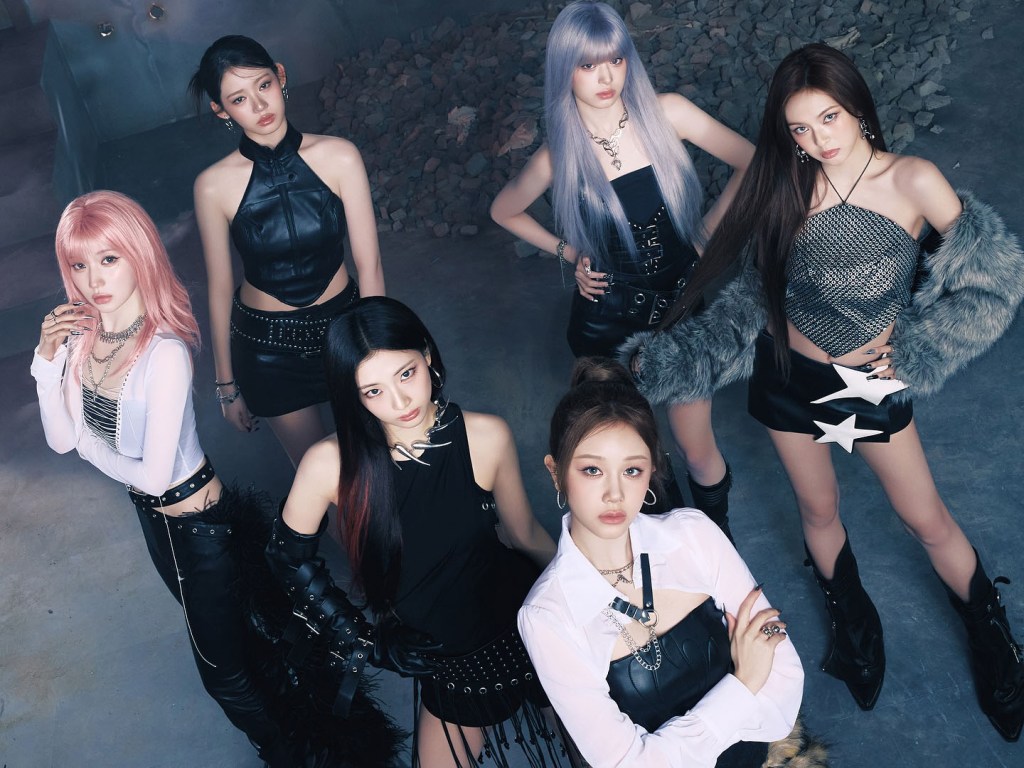
I did not make a typo in the title. Yes, I can see clearly that the seven members of BABYMONSTER are women, not men. But the central message of “We Go Up” is so plainly what it is that I have no choice but to accuse BABYMONSTER of glorifying the very worst of their opposite sex.
Every single BABYMONSTER M/V thus far has felt like the video directors’ frantic scramble for external validation. In “Batter Up,” Ruka wears a animal-print fur coat and lounges around formidable sports cars. In “SHEESH,” Rami conducts a room full of fire, and Ahyeon storms up a set of stairs, dress dramatically whipping behind her like she’s a princess coming to overtake a castle. In “FOREVER,” the girls wear brand-name fashion, sleep in palace-like hotels, fly through the sky in floating cars, and dance around glass exhibits of glittering silver high-heels. BABYMONSTER’s strategy to attract an audience: impress, wow, and flaunt.
In “We Go Up,” though, the directors pull out all the stops. Leveled-up to some sort of word-class assassin status, no one, it seems, has the strength to defeat the girls of BABYMONSTER. Asa single-handedly slashes through a whole room of opponents, samurai-style, then somehow splits an arrow open in midair while it’s streaking towards her body. Chiquita, at 16, sends a Travis Kelce-looking guy spiraling to the floor with one expertly-placed kick. Pharita summons a swarm of crows and blows up a mountain with one electric-blue flash of her eyes. Ahyeon, with a single bomb, sends her pursuers into an exploding orange cloud of debris. The M/V is no doubt cool, but feels like the work of an insecure debut author: in constant need to remind the viewer of its theme, hitting the viewer over the head over and over again that the girls are strong. BABYMONSTER is strong. They’re strong.
Their strength feels horribly inauthentic. It’s superficial. It’s performative. Whether or not they realize it themselves, they say it in their own lyrics:
“We go up like, whoa 우린 killas, killas
We go up like, whoa 우린 villains, villains”
**우린 means “we’re.”
Given the opportunity to describe their ascent with any word in the dictionary, BABYMONSTER can choose no better word than “whoa.” A word said by another. A word said out of admiration or intimidation. A word indicating external validation. They’re doing all this–murdering people, blowing up buildings, incinerating mountains–just to get an impressed “woah” out of an audience. They call themselves “killas” and “villains” but possess absolutely none of the lust for justice or blazing moral purpose of killers or villains–they’re killing people for no other reason than to show off their strength, to gain the fear and respect of their viewers.
I am so personally disappointed with this narrow definition of strength. BABYMONSTER defines strength as simply brute strength–the power to do harm, intimidate, or kill–and believes such strength is admirable enough. I starkly disagree. Character strength–the strength of one to endure hardship, to acknowledge weakness, to display vulnerability–is a thousand times more valuable. I’d say the unnamed protagonist of NewJeans’ “Ditto” M/V, who constructs imaginary friends in an attempt to escape her loneliness, is so much stronger than all the BABYMONSTER girls put together. She harms no one, intimidates no one, kills no one, but she endures her weaknesses on her own–something that takes so much more strength than sapping the strength out of others and something that the BABYMONSTER M/Vs have never shown their girls doing.
Sorry if I sounded like an English teacher doing cHaRaCtEr aNaLySiS there. But I honestly, truly believe that BABYMONSTER’s view of strength is so undeniably toxic–toxic to humanity in general, but also especially toxic to women.
The idea that strength just equals brute strength is the basis of toxic masculinity. Society, perhaps due to their expectations that men must fight their wars and provide for their families and be physically stronger than women, has always imposed an unfair expectation on men to always display their strength. “Boys don’t cry,” they say. “Men don’t need therapy,” they say. But this hollow pursuit of strength often leads to the faulty spiral of equating strength with displays of brute, physical strength–the most fear-inducing, respect-earning, and externally validating form of strength. That’s where toxic, insecure masculinity starts brewing, and starts to be a danger to the men who possess it and the others around them.
BABYMONSTER’s assumptions on strength are nothing new, then. What is new, however, is their usage of women to portray this take on strength. Women as blood-thirsty samurais. Women as merciless sharpshooters. Women as powerful yet purposeless melee-combat winners. That can certainly be cool, but also exceedingly dangerous. Are they trying to suggest that women can only be equally valued as men if they subscribe to the toxic idea of physical dominance and brute strength? Are they trying to suggest that feminism can only be advanced by advancing the image of women’s physical strength?
YG, please use your damn brain for a few more seconds before creating these M/Vs. No, bro. Please stop doing this. You are confining women to outdated, worn-out, and literally harmful ideas. You are not advancing women–you are taking them back in time.
Also, I am extremely interested in your plans for future BABYMONSTER M/Vs. Having already gone this far with “We Go Up,” how will you further attempt to impress your audience and prove BABYMONSTER’s strength in the future? What will you have the girls do next: build nukes? Blast entire cities to rubble? Incite mass murder?
So, no, Ruka, you’re wrong with your statement that “You ain’t never seen the typa show we ‘boutta show ya.” I have. Many, many times over. And, from one woman to another, it’s called toxic masculinity.
⋆˙ i’m so done with poorly thought-out attempts at “feminism” ⋆˙
 ✦⋆˙ eighteen rants ⋆˙✦
Leave a comment